.png)
Wild Learning Spaces - Episode One
- Little Sprouts
- Oct 16, 2025
- 4 min read

Herdsman Lake Discovery Centre
This week’s Wild Learning Space took us to Herdsman Lake Discovery Centre — and wow, it did not disappoint.
Right in the middle of Perth (about 6 km northwest of the city), Herdsman Lake is a calm, nature-filled pocket of wetlands, birds, and bushland that feels miles away from the noise.
The Discovery Centre is open most mornings and Saturdays from 9 am–2 pm (check the website to double check before you go!), and entry is just $5 per person — an absolute bargain for how much there is to explore. Inside you’ll find native displays, puzzles, microscopes, and local creatures to meet.
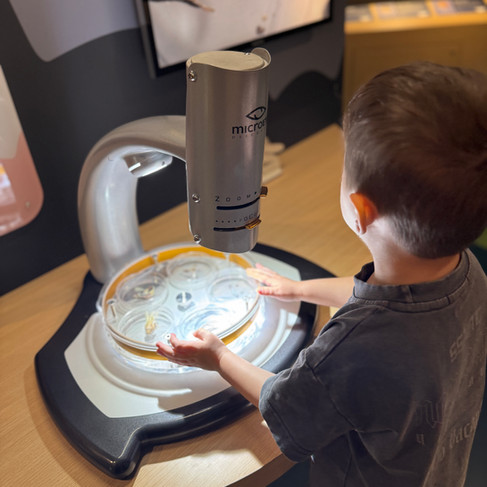
We started in the puzzle and play room, which instantly drew my little one in — lots of hands-on learning, sensory discovery, and curious minds at work. It was packed full of toys, teddies, puzzles and books. Then came the digital microscope (a huge hit), where we got to see some creepy crawlies really close up!
In the main area, we met a few locals — a bobtail lizard, turtle and a stick insect (the true star of the show), make sure you grab a sheet from the desk which includes a checklist to make sure you dont miss any of them! Next we took ourselves upstairs and found binoculars for a bit of bird watching over the lake. Once we were finished inside we wandered the trails looking for ducks, bugs, and hidden treasures in the logs.
If you’ve got a homeschooler or a curious explorer, this place is perfect for weaving learning into play.
Here are a few learning ideas you can continue at home:
. Wetland Ecosystem Study & Water Cycles
Use maps (print or digital) to trace how Herdsman Lake connects to its catchment area and drains, and talk about how urban runoff, rain, and land use affect water levels.
Set up a small model or terrarium to simulate how water moves through soil, plants, and into streams or wetlands.
Measure rainfall over a few weeks and compare with observations at the lake (were some parts wetter or drier?).
Investigate how plants like reeds and Typha (rushes) help filter water and provide habitat.
2. Birdography & Migration Tracking
Make a “species journal” of all the birds you saw (common, native, migratory) and research each one’s diet, habitat, and migration patterns. Herdsman Lake has over 100 observed species!
Use eBird or local birding apps to log your sightings and compare with other observers.
Create a timeline or map tracking migration routes of birds that come through Herdsman.
Tie into art: sketch the birds with notes on wing shape, beak length, posture, and habitat.
3. Invertebrates and Mini-Creature Ecology
Collect (carefully & temporarily) soil samples, leaf litter, and log slices. Use magnifiers at home to identify insects, larvae, mites, snails, etc.
Use an identification key (print or online) to classify what you find.
Focus studies: what body parts do insects have? How do they move? How do they protect themselves?
Compare “microhabitats” (under bark, in soil, under stones) and chart which creatures prefer which microhabitat.
4. Nature Journalling & Longitudinal Observation
Begin a nature journal: daily or weekly entries with sketches, observations, weather, changes in plants or wildlife.
Revisit the same patch (tree, log, puddle) over weeks or months and note changes (growth, decay, returned insects).
Add prompts: "What did I expect to see vs what I saw?" or "What surprised me?"
Include reflective pages: how did I feel being outside? What senses did I use (sight, smell, touch, sound)?
5. Habitat Restoration, Citizen Science & Stewardship
Plant native seedlings you research (from local species around Herdsman Lake) and monitor their growth near your home or school yard.
Use citizen science platforms (like iNaturalist or the online surveys of the Discovery Centre) to upload your observations of plants, invertebrates, and waterbirds. WA Gould League
Create a “Nature Steward” project: monitor litter, count the number of species you see, test small patches of soil or water for quality (pH, clarity) using kits.
Develop hypotheses: e.g. “If we reduce rubbish, then more insects will appear.” Test and reflect.
6. Habitat Zoning & Design Thinking
Sketch or map the different “zones” you saw at the lake (wetland, sedgeland, woodland edges, boardwalks).
Discuss how different zones support different plants and animals.
Design your “ideal wild corner” at home or in your backyard: what features would you include (water, logs, native plants, shelter) to attract wildlife?
Model your design using natural materials or scaled drawings.
7. Seasonal Cycles, Plant Phenology & Climate Awareness
Track when certain plants flower, fruit, lose leaves or seed. Relate it to local seasons, rainfall, and daylight changes.
Compare historical photographs (if available) of Herdsman Lake vegetation to now — talk about change over time and human impact.
Conduct experiments: grow seedlings under different light or water conditions and compare.
Use the lake as a case study to discuss how climate change, urban development, water use, and introduced species affect wetlands.




Comments